Attalea taam
Táam



Country Of Origin: Colombia
![O:31:"craft\elements\db\CategoryQuery":84:{s:27:"yii\base\Component_events";a:0:{}s:35:"yii\base\Component_eventWildcards";a:0:{}s:30:"yii\base\Component_behaviors";a:1:{s:12:"customFields";O:35:"craft\behaviors\CustomFieldBehavior":169:{s:5:"owner";r:1;s:34:"yii\base\Behavior_attachedEvents";a:0:{}s:10:"hasMethods";b:1;s:16:"canSetProperties";b:1;s:8:"address1";N;s:8:"address2";N;s:4:"city";N;s:5:"state";N;s:3:"zip";N;s:7:"country";N;s:11:"climateZone";N;s:6:"czZone";N;s:6:"czCity";N;s:10:"czProvince";N;s:9:"firstName";N;s:8:"lastName";N;s:5:"email";N;s:8:"password";N;s:12:"emailAddress";N;s:6:"photos";N;s:10:"photoSize1";N;s:14:"photoLocation1";N;s:14:"photoPlanting1";N;s:6:"photo3";N;s:6:"photo4";N;s:6:"photo5";N;s:14:"photoLocation2";N;s:14:"photoLocation3";N;s:14:"photoLocation4";N;s:14:"photoLocation5";N;s:10:"photoSize2";N;s:10:"photoSize3";N;s:10:"photoSize4";N;s:10:"photoSize5";N;s:14:"photoPlanting2";N;s:14:"photoPlanting3";N;s:14:"photoPlanting4";N;s:14:"photoPlanting5";N;s:10:"photoGroup";N;s:5:"photo";N;s:4:"size";N;s:8:"location";N;s:14:"typeOfPlanting";N;s:5:"agree";N;s:4:"body";N;s:10:"commonName";N;s:4:"zone";N;s:7:"minTemp";N;s:7:"zoneAlt";N;s:10:"growthRate";N;s:17:"lightRequirements";N;s:8:"heightFt";N;s:7:"heightM";N;s:9:"soilPhMin";N;s:9:"soilPhMax";N;s:8:"priority";N;s:5:"seeds";N;s:8:"seedling";N;s:8:"fourInch";N;s:9:"oneGallon";N;s:11:"threeGallon";N;s:13:"photoSpecies1";N;s:13:"photoSpecies2";N;s:13:"photoSpecies3";N;s:13:"photoSpecies4";N;s:13:"photoSpecies5";N;s:12:"abbreviation";N;s:15:"metaDescription";N;s:13:"metaPageTitle";N;s:11:"socialImage";N;s:19:"descriptionFallback";N;s:17:"globalSocialImage";N;s:13:"titleFallback";N;s:16:"pollAnswerMatrix";N;s:5:"label";N;s:12:"selectedPoll";N;s:5:"image";N;s:10:"recentPoll";N;s:10:"userPhotos";N;s:5:"sizeX";N;s:10:"imageTitle";N;s:21:"inPersonalCollectionX";N;s:9:"locationX";N;s:8:"speciesX";N;s:9:"photoDump";N;s:7:"species";N;s:19:"inPrivateCollection";N;s:15:"typeOfPlantingX";N;s:20:"formerScientificName";N;s:11:"headingList";N;s:4:"text";N;s:7:"heading";N;s:8:"careTips";N;s:8:"mapImage";N;s:13:"speciesPhotos";N;s:4:"user";N;s:20:"inPersonalCollection";N;s:11:"speciesPage";N;s:11:"assignments";N;s:16:"leafTypeDropdown";N;s:23:"countryOfOriginCategory";N;s:10:"linkTarget";N;s:11:"buttonLabel";N;s:12:"externalLink";N;s:12:"internalLink";N;s:9:"inHabitat";N;s:21:"skipPhotoFieldsDetail";N;s:20:"skipPhotoFieldsLabel";N;s:20:"recentSpeciesUpdates";N;s:14:"twitterProfile";N;s:16:"instagramProfile";N;s:15:"linkedinProfile";N;s:15:"facebookProfile";N;s:10:"crownshaft";N;s:14:"threadsProfile";N;s:16:"temperatureRange";N;s:9:"zoneTitle";N;s:15:"newsDescription";N;s:12:"newsImageUrl";N;s:8:"newsLink";N;s:10:"newsSource";N;s:28:"conservationScaleDescription";N;s:28:"conservationScaleStatusColor";N;s:17:"conservationScale";N;s:19:"userFacebookProfile";N;s:20:"userInstagramProfile";N;s:18:"userThreadsProfile";N;s:14:"imagePositionX";N;s:16:"shortDescription";N;s:11:"buttonTitle";N;s:14:"imagePositionY";N;s:6:"newTab";N;s:7:"linkUrl";N;s:10:"hideAuthor";N;s:11:"linkEntries";N;s:14:"authorOverride";N;s:8:"category";N;s:13:"contentBlocks";N;s:12:"callToAction";N;s:12:"calloutTitle";N;s:8:"embedUrl";N;s:6:"images";N;s:15:"singleImageSize";N;s:12:"shopCategory";N;s:14:"shopifyProduct";N;s:13:"speciesSelect";N;s:8:"products";N;s:14:"blueskyProfile";N;s:18:"userBlueskyProfile";N;s:7:"subject";N;s:6:"soilPh";N;s:8:"soilType";N;s:5:"habit";N;s:9:"continent";N;s:7:"website";N;s:14:"attractionName";N;s:7:"address";N;s:14:"collectionSize";N;s:11:"ratingImage";N;s:12:"gardenPhotos";N;s:6:"garden";N;s:16:"whereThePalmsAre";N;s:6:"rating";N;s:18:"ratingDescriptions";N;s:10:"level3Text";N;s:10:"level1Text";N;s:10:"level2Text";N;s:14:"youtubeProfile";N;s:55:"craft\behaviors\CustomFieldBehavior_customFieldValues";a:0:{}}}s:6:"select";a:1:{s:2:"**";s:2:"**";}s:12:"selectOption";N;s:8:"distinct";b:0;s:4:"from";N;s:7:"groupBy";N;s:4:"join";a:1:{i:0;a:3:{i:0;s:10:"INNER JOIN";i:1;a:1:{s:9:"relations";s:14:"{{%relations}}";}i:2;a:4:{i:0;s:3:"and";i:1;s:40:"[[relations.targetId]] = [[elements.id]]";i:2;a:2:{s:18:"relations.sourceId";i:537505;s:17:"relations.fieldId";i:150;}i:3;a:3:{i:0;s:2:"or";i:1;a:1:{s:22:"relations.sourceSiteId";N;}i:2;a:1:{s:22:"relations.sourceSiteId";i:1;}}}}}s:6:"having";N;s:5:"union";N;s:11:"withQueries";N;s:6:"params";a:0:{}s:18:"queryCacheDuration";N;s:20:"queryCacheDependency";N;s:5:"where";N;s:5:"limit";N;s:6:"offset";N;s:7:"orderBy";s:0:"";s:7:"indexBy";N;s:16:"emulateExecution";b:0;s:11:"elementType";s:23:"craft\elements\Category";s:5:"query";N;s:8:"subQuery";N;s:12:"contentTable";s:12:"{{%content}}";s:12:"customFields";N;s:9:"inReverse";b:0;s:7:"asArray";b:0;s:18:"ignorePlaceholders";b:0;s:6:"drafts";b:0;s:17:"provisionalDrafts";b:0;s:7:"draftId";N;s:7:"draftOf";N;s:12:"draftCreator";N;s:15:"savedDraftsOnly";b:0;s:9:"revisions";b:0;s:10:"revisionId";N;s:10:"revisionOf";N;s:15:"revisionCreator";N;s:2:"id";N;s:3:"uid";N;s:14:"siteSettingsId";N;s:10:"fixedOrder";b:0;s:6:"status";a:1:{i:0;s:7:"enabled";}s:8:"archived";b:0;s:7:"trashed";b:0;s:11:"dateCreated";N;s:11:"dateUpdated";N;s:6:"siteId";i:1;s:6:"unique";b:0;s:11:"preferSites";N;s:6:"leaves";b:0;s:9:"relatedTo";N;s:5:"title";N;s:4:"slug";N;s:3:"uri";N;s:6:"search";N;s:3:"ref";N;s:4:"with";N;s:16:"withCustomFields";b:1;s:13:"withStructure";b:1;s:11:"structureId";N;s:5:"level";N;s:14:"hasDescendants";N;s:10:"ancestorOf";N;s:12:"ancestorDist";N;s:12:"descendantOf";N;s:14:"descendantDist";N;s:9:"siblingOf";N;s:13:"prevSiblingOf";N;s:13:"nextSiblingOf";N;s:16:"positionedBefore";N;s:15:"positionedAfter";N;s:17:"*defaultOrderBy";a:2:{s:20:"elements.dateCreated";i:3;s:11:"elements.id";i:3;}s:53:"craft\elements\db\ElementQuery_placeholderCondition";N;s:51:"craft\elements\db\ElementQuery_placeholderSiteIds";N;s:39:"craft\elements\db\ElementQuery_result";N;s:47:"craft\elements\db\ElementQuery_resultCriteria";N;s:46:"craft\elements\db\ElementQuery_searchResults";N;s:42:"craft\elements\db\ElementQuery_cacheTags";N;s:42:"craft\elements\db\ElementQuery_columnMap";a:0:{}s:51:"craft\elements\db\ElementQuery_joinedElementTable";b:0;s:8:"editable";b:0;s:7:"groupId";i:11;} map image](https://projectpalm.net/assets/species/attalea-taam/_600xAUTO_fit_center-center_100_none/map-of-Colombia.png)
About Attalea taam
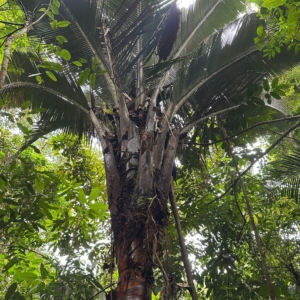
This is a towering solitary palm with a thick, upright trunk marked by beautiful orange-brown rings that trace the scars of old leaves, giving the stem a striking banded appearance. At the top of the trunk sits a full crown of massive feather-shaped leaves that rise upward and outward, forming a commanding canopy presence in the rainforest. The flowering structures emerge just below the crown and eventually develop into dense clusters of oval fruits that ripen to a warm yellow-brown color. Inside each fruit is a single seed surrounded by a sweet, edible orange flesh that is valued by both wildlife and the Indigenous Cacua people. In its native habitat, this palm grows high into the forest canopy and can become one of the dominant tree-like palms in the landscape, helping define the structure of the Amazon rainforest itself. Because this species was only formally identified in 2026 and remains confined to a remote region of the Colombian Amazon, it is currently unknown in cultivation and represents one of the newest canopy palm discoveries in the world.
| Climate Zone | 10b |
| Min Temp (F/C) | 35 to 40 F / 2 to 4 C |
| Leaf Type | Pinnate |
| Height | 72 Ft / 22 M |
| Growth Rate | Slow to Moderate |
| Conservation Status |
Not Evaluated
|
| Habit | Solitary |
| Soil pH | 5.0-5.9 (Acidic) |
| Soil Type | Loamy |
Cultivation Tips
Because Attalea taam is a large canopy palm native to mature Amazon rainforest, cultivation requirements can be inferred from closely related species such as Attalea maripa and Attalea cohune.
Attalea taam would require a large, open landscape location with ample vertical space, as it develops into a tall canopy palm with a massive trunk and expansive crown. It likely prefers full sun at maturity but would benefit from partial shade during its early establishment phase, as seedlings naturally germinate beneath forest canopy. The species is expected to perform best in rich, well-drained tropical soils with high organic content, reflecting its native terra firme rainforest habitat. Regular watering during establishment is essential, but mature specimens would likely tolerate seasonal dry periods due to their deep root systems typical of Attalea species. Fertilization with a balanced slow-release palm fertilizer three times annually would support optimal growth, especially in nutrient-poor cultivated soils.
To Contribute To Project Palm!